KSeF for restaurants
KSeF invoices
are your costs.
Since KSeF, invoices from your suppliers arrive as data, not paper. For the first time, a restaurant’s costs can count themselves. Owlly collects them every hour.
14 days of the whole back office free · no card · connect KSeF in about 15 minutes
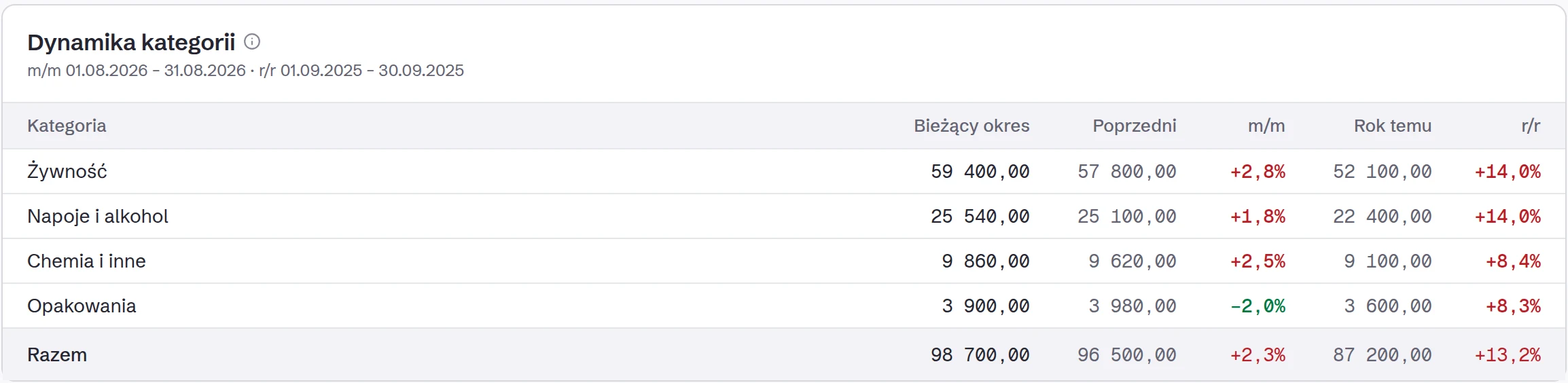
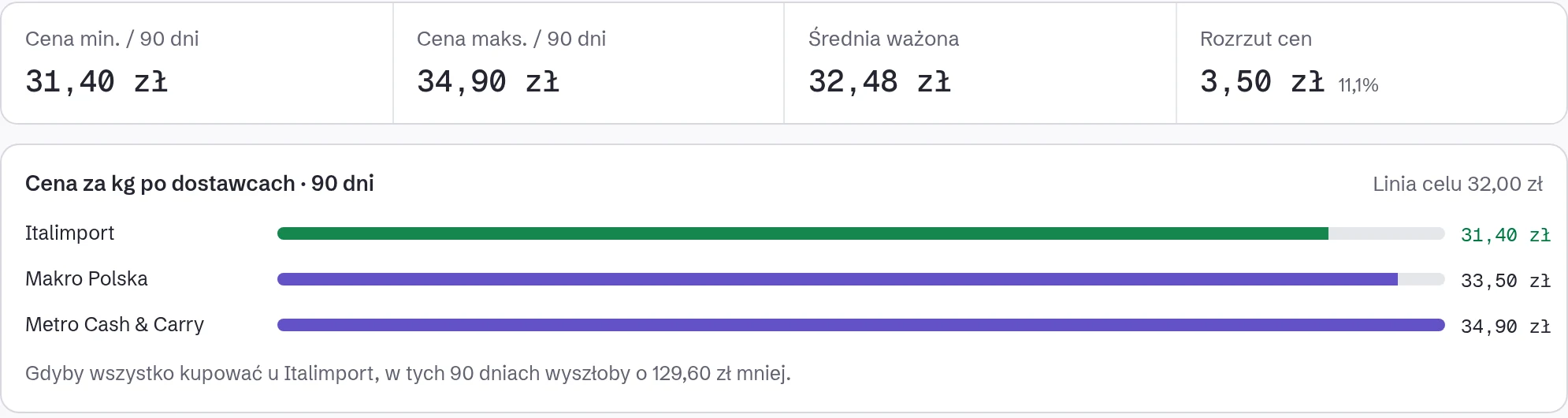
Connect KSeF. See your last month.
Owlly pulls the last 30 days of invoices from KSeF and turns them into numbers: what you bought, from whom and for how much.
- 1Log in to KSeF and create a token for Owlly. We’ll show you every click.
- 2Paste it into Owlly.
- 330 days of invoices are in. New ones arrive every hour.
Does your accounting office handle KSeF? Ask them for a token for Owlly.
Pulling purchase invoices needs only a token that can read them. If you have several venues, each can have its own NIP or use the company’s.
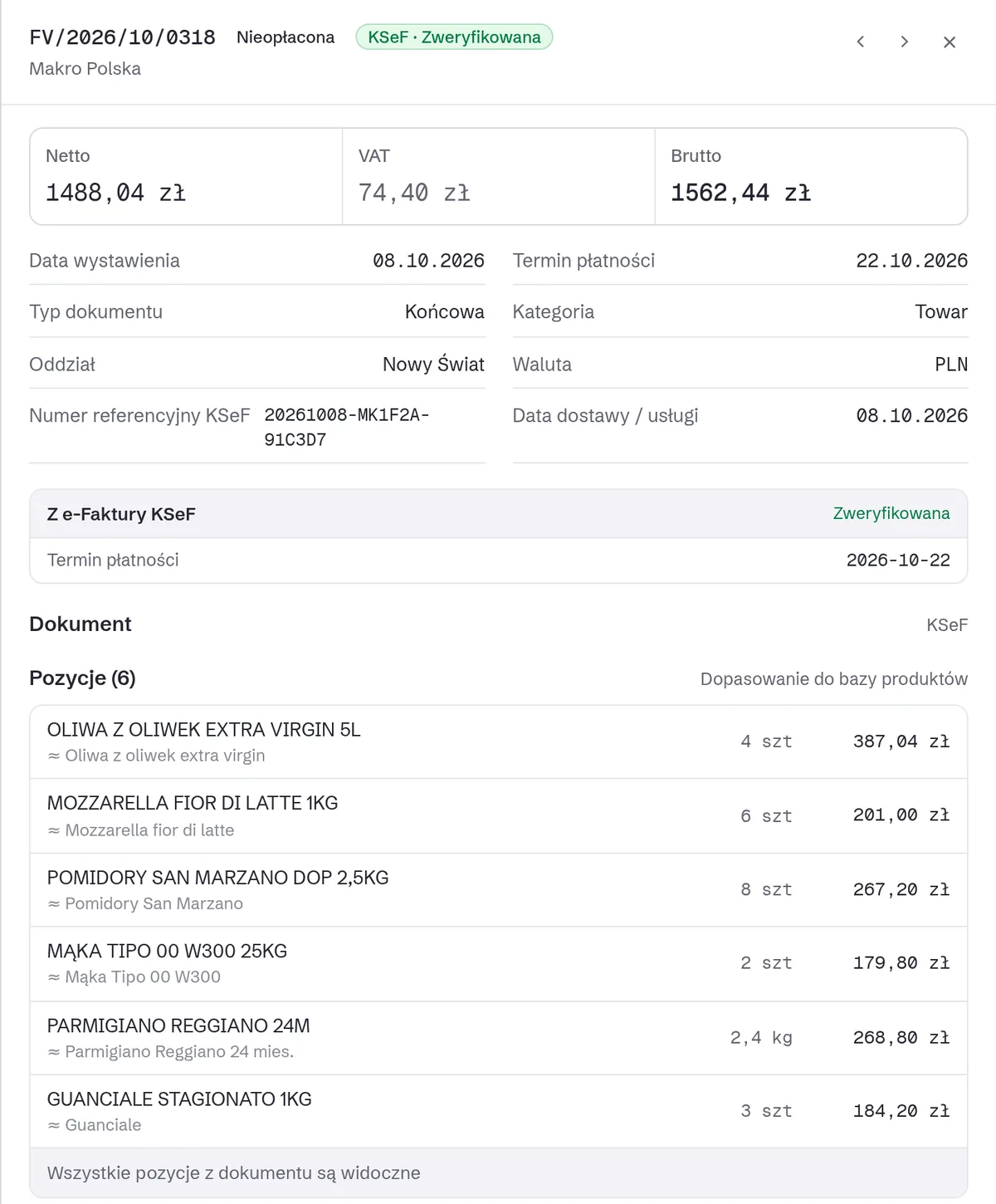
The invoice doesn’t go into an archive. It goes into your costs.
Recipes and dish costs are in the 249 zł plan. KSeF intake, ingredients, prices and alerts are in every plan, from 149 zł.
Not every supplier is in KSeF. So there are three ways in.
All three end in the same place and go the same way: line, ingredient, price.
The same invoice from KSeF and by e-mail? Owlly recognises it by the supplier’s NIP, the number and the date, so it never counts it twice.
An expired token looks like a quiet week. Owlly notices the difference.
There is more in KSeF than mozzarella.
Electricity, rent, cleaning products, laundry, waste collection, insurance, the coffee machine lease: invoices from suppliers who issue in KSeF are in one place, in the same structure. You see the venue’s fixed costs next to purchases, with no binder.
KSeF
KSeF in a restaurant: questions and answers
KSeF is the National e-Invoice System, a central Ministry of Finance database in which, since 1 February 2026, every business in Poland must receive purchase invoices.
What is KSeF, and who in hospitality does it apply to?
The National e-Invoice System (Krajowy System e-Faktur, KSeF) is a central invoice database run by the Polish Ministry of Finance. An invoice is no longer a file your supplier sends you — it is a structured document the supplier places in the system and you collect from there.
It applies to every business registered for VAT, which in hospitality means practically everyone: restaurants, pizzerias, cafés, bars, caterers and food trucks. It makes no difference whether you have one venue or fifteen, or whether you trade as a sole trader or a company.
For a kitchen the consequence that matters is this: purchase invoices from suppliers who issue them in KSeF (the wholesaler, the butcher, the greengrocer, the drinks supplier) are in the system as data. You do not have to wait for them, ask for a duplicate, or hunt for them in email. Owlly collects them every hour.
That changes the nature of the problem. For years the hardest part of computing costs was GETTING the documents. From 2026 the documents are given — the difficulty moves to understanding them.
From when is KSeF mandatory?
Two dates, and both are worth knowing, because they cover different things.
1 February 2026: the obligation to RECEIVE. From that day every business must be able to accept invoices from KSeF. This is the date that governs your purchase invoices, and the one that matters for computing costs.
1 April 2026: the obligation to issue sales invoices in the system covers almost every VAT payer. That obligation sits on your side and you meet it where you issue invoices today, for example in your accounting software or in the Ministry’s own app. The Owlly till (the 249 zł plan) issues guests’ VAT invoices and sends them to KSeF, correction invoices included. To pull purchase invoices, Owlly needs only read access to them.
The practical conclusion: the receiving obligation already applies to you, so your suppliers’ invoices are in KSeF whether or not you collect them.
Does a restaurant need separate KSeF software?
It does not. To meet the obligation itself, the Ministry of Finance’s free app is enough — it will accept invoices and let you download them. If your venue has a dozen or so invoices a month, that may well be sufficient.
The real question is what happens to an invoice AFTER you receive it. The government app is an archive: it does not know your recipes, it keeps no price history, it will not warn you that beef has gone up 8%, and it will not recompute the cost of the twelve dishes that beef appears in.
So the actual choice is not “government app or software”, it is “should the invoice be archived, or read”. If you are computing food cost in a spreadsheet anyway, software that receives the invoice and costs your dishes at its prices replaces two jobs at once.
It is also worth checking what “KSeF support” actually means at any vendor you are considering. In accounting software it usually means: the document can be imported. Automatic receipt means: invoices arrive on their own, on a schedule, without anyone clicking. That is the difference between a letterbox and someone who empties it.
How do you connect a venue to KSeF, step by step?
You need access to your company’s KSeF account — the same one your accountant uses. The whole thing takes about fifteen minutes and needs nobody’s technical help.
You sign in to KSeF and generate a token with READ access to purchase invoices. That is enough to pull them.
You paste the token into one field in Owlly’s settings. From that moment purchase invoices are pulled automatically, every hour.
On the first import Owlly also pulls the invoices from the last 30 days, so price history does not start from zero on the day you connect.
If you have several venues, each branch can carry its own tax identity or inherit head office’s — connections are routed accordingly and invoices land in the right branch.
What about invoices a supplier does not issue in KSeF?
There will be some, and for a good while. The small greengrocer, the bakery down the road, the supplier who always left paper with the delivery — some will start issuing in KSeF late, some will keep emailing a PDF alongside.
That is why KSeF cannot be the only channel. In Owlly three run side by side: KSeF every hour, an email inbox checked every 15 minutes, and a phone photograph for the paper a driver leaves with the delivery.
All three end in the same place and take the same path: line items recognised, matched to an ingredient in the base, price updated. From the point of view of computing costs it does not matter which way the document came in.
There is one case worth knowing about: the same invoice can arrive by two routes — from KSeF and by email — within minutes of each other. The duplicate is caught on the issuer’s tax ID, the document number and the issue date, so it neither inflates costs nor moves stock twice.
Does KSeF cover receipts and invoices issued against a receipt?
Fiscal receipts do not go to KSeF. Consumer sales are settled through the fiscal till and stay that way — fiscalisation, the printer and daily reports all work unchanged.
An invoice issued against a receipt, which a guest asks for on behalf of their company, is different. That is a sales invoice and follows the same rules as the rest.
For most hospitality venues the practical consequence is small, because such invoices are a minor share of sales. It is worth checking how your till or accounting software handles the case. On the Owlly till (the 249 zł plan) you issue the guest’s VAT invoice on the till, and the till sends it to KSeF.
What does KSeF handling cost in a restaurant?
The Ministry of Finance app is free. A cost only appears when you want somebody to read those invoices rather than merely store them.
In Owlly, KSeF handling starts with the AI Invoices & Suppliers plan at 149 zł net per venue per month.
That price covers hourly receipt of invoices from KSeF, invoices from an email inbox and from a photo, data validation, a searchable archive, the ingredient catalogue, payment due dates, orders to suppliers and alerts on supplier price rises, which you see the morning after the invoice. Rotas are in the 199 zł plan; recipes, food cost, stock and the forecast are in the 249 zł plan.
There is no onboarding fee and no term commitment.
What does KSeF give you beyond receiving invoices?
This is the part almost nobody writes about, and for a restaurant it matters more than compliance itself.
KSeF is not only food invoices. Electricity, rent, cleaning chemicals, laundry, waste collection, insurance, the coffee machine lease, subscriptions: invoices from suppliers who issue in KSeF appear in one place, in the same structure.
A restaurant that connects KSeF for the obligation gets a large part of its costs in one place as a side effect, without retyping binders. Questions that used to be theoretical become answerable: what electricity costs against revenue, whether cleaning chemicals are growing faster than turnover, what the venue’s fixed costs for the month are.
Start with your invoices.
14 days of the whole back office free · no card · connect KSeF in about 15 minutes
Know your numbers.